
Looking for the best place to stay in Southern Laos? The short answer: base yourself in Champasak if you want culture, riverside charm and easy access to the UNESCO temple of Wat Phou; choose Pakse only as a transit stop; head to the 4,000 Islands (Si Phan Don) for hammock-and-river life; and add the Bolaven Plateau for waterfalls and coffee farms. Most travellers combine two or three of these bases over 4 to 6 days.
Southern Laos is compact enough that you do not have to pick only one. The four places below sit within a few hours of each other, and the region rewards travellers who settle somewhere pleasant and make day trips from it, rather than packing and unpacking every night.
Where is the best place to stay in Southern Laos?
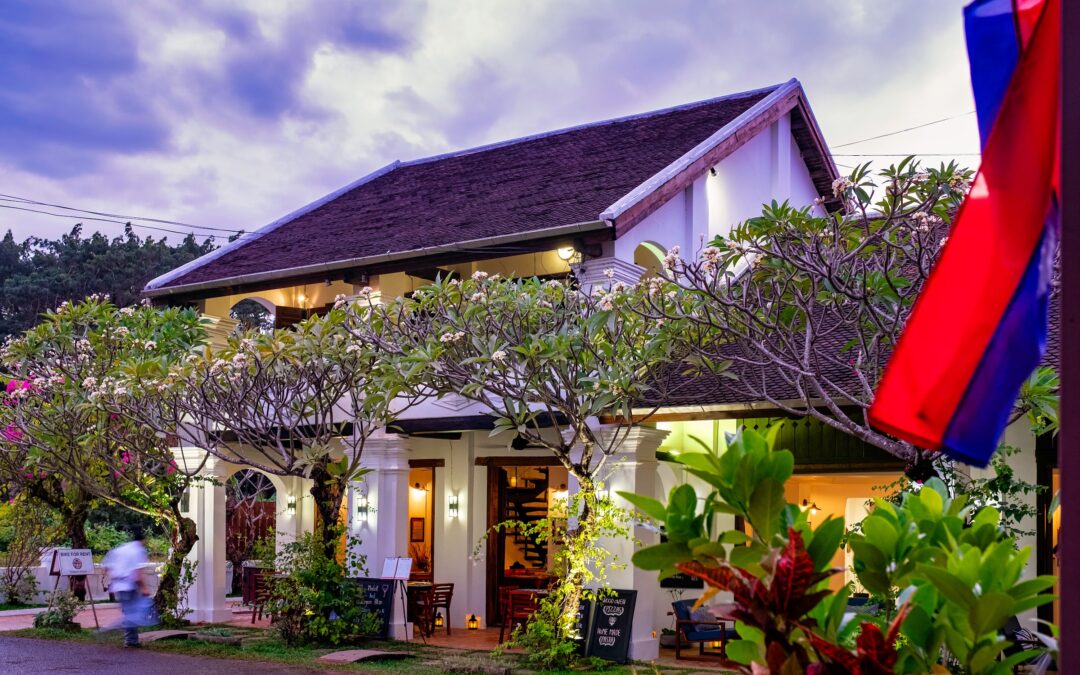
For most visitors, Champasak is the best base in Southern Laos. This small heritage town on the Mekong River is 30 minutes from Wat Phou, free of heavy traffic, and offers the region’s most atmospheric accommodation — including Residence Bassac, a 14-room boutique hotel set in a restored century-old Chinese trading house on the riverside road, with its restaurant Soum Noum serving Lao and Mediterranean cuisine and a private sala overlooking the Mekong.
It is also the only one of the four bases from which the temple, the west-bank villages, the Mekong islands and the plateau are all within reach of a single day’s outing.
Choosing your base at a glance
- Champasak — heritage town, the Mekong and Wat Phou. Two to four nights. The easiest base for day trips in every direction.
- Pakse — the airport, the buses, the banks and the pharmacies. One night, before or after a flight. Not a destination in itself.
- Si Phan Don (4,000 Islands) — slow river days and waterfalls. One or two nights, or a long day trip from Champasak.
- Bolaven Plateau — cool air, coffee and falls. A day trip, or one night at a plantation guesthouse.
Pakse — the gateway, not the destination
Pakse has the region’s airport (PKZ) and bus connections, plus banks and pharmacies. It is practical for one night before or after a flight, but it is a working town rather than a place to linger. From Pakse, Champasak is about 30 km — roughly 45 minutes by road.
Most itineraries use Pakse twice, once on arrival and once on the way out, and spend everything in between further south. If you land late in the evening or leave at dawn, a night here makes sense; otherwise, travel straight on. Our guide on how to get to Champasak sets out the routes in detail.
Champasak — culture, Wat Phou and the Mekong
Champasak is a former royal capital stretched along the west bank of the Mekong: frangipani-lined streets, colonial and traditional houses, riverside temples and no through-trucks. It is the natural base for visiting Wat Phou, the pre-Angkorian temple complex classified as a UNESCO World Heritage Site, and for boat trips to Don Daeng island or the forest temple of Vat Tomo across the river.
Days here have a rhythm of their own: the morning market before the heat, the temple early, the hours after lunch in the shade of a garden, and the sunset from the riverbank. Beyond Wat Phou there is Vat Muang Kang, the oldest temple still in use in Champasak, a flat and shaded cycle ride along the west bank, and the crossing to Vat Tomo. Our guide to the best things to do in Champasak takes them one by one.
Where to stay in Champasak: Residence Bassac offers suites and garden rooms in Champasak. Our travel desk can help arrange Wat Phou visits, Mekong boat journeys and Bolaven Plateau excursions. Check current rates and availability for your travel dates.
Si Phan Don (4,000 Islands) — slow river life
Two hours further south, the Mekong widens into a maze of islands. Don Det attracts backpackers; Don Khone is quieter, with the Li Phi waterfalls and old French railway relics. Accommodation is mostly simple guesthouses; many travellers visit as a day trip or spend one or two nights.
From Champasak, reaching the islands means two to three hours by road to Nakasang, then a boat crossing of about twenty minutes. Khone Phapheng, on the eastern channel, is the largest waterfall in South-East Asia by volume. One thing worth knowing before you plan the day: the Irrawaddy dolphins that once drew visitors to this stretch of the river disappeared from Laos in 2022 and can no longer be seen there. Our guide to the 4,000 Islands from Champasak explains what the day actually involves.
Bolaven Plateau — coffee and waterfalls
East of Pakse, the Bolaven Plateau rises to 1,300 m: cooler air, coffee plantations and spectacular falls such as Tad Fane and Tad Yuang. It works well as a day trip from Champasak or Pakse, or with one night in a plantation guesthouse.
Tad Fane, in Dong Hua Sao National Park, is the highest fall on the plateau at around 120 m. Tad Yuang — also written Tad Gneuang — is the easier of the two to walk down to. The coffee harvest runs from October to February, which is also the driest part of the year up there; in the green season the falls are at their fullest and the plantations are quiet. Our Bolaven Plateau waterfall guide covers which ones to see and when.
What to expect from accommodation in Southern Laos
Standards differ markedly between the four bases. Pakse has conventional town hotels. Champasak has a small number of restored heritage houses and riverside guesthouses, each with very few rooms. On the islands, accommodation is mostly simple and family-run. On the plateau, a handful of plantation guesthouses. Nothing in the region is large, and the dry season from November to April is the busy half of the year — if your dates are fixed, it is worth securing a room well ahead.
Suggested itinerary: 5 days in Southern Laos
Day 1: arrive in Pakse, transfer to Champasak. Day 2: Wat Phou early in the day, west-bank temples by bicycle. Day 3: Mekong boat day — Vat Tomo and Don Daeng. Day 4: Bolaven Plateau waterfalls and coffee. Day 5: 4,000 Islands day trip, or a free morning by the river before departure.
If you have less time, our three-day itinerary for Southern Laos covers the same ground more tightly. And before you fix the dates, see when to come to Southern Laos, month by month along the Mekong.
Frequently asked questions
What is the best hotel near Wat Phou?
Residence Bassac in Champasak is a boutique hotel near Wat Phou — about 10 km from the temple — with 14 renovated rooms, a riverside sala and the Soum Noum restaurant.
Should I stay in Pakse or in Champasak?
Champasak, unless your flight times force a night in Pakse. Pakse has the airport and the buses; Champasak has the temple, the river and the quiet. The two are about 45 minutes apart by road.
When is the best time to visit Southern Laos?
November to February is dry and pleasant (21–30°C). March–April is hot; the green season (May–October) brings lush landscapes and full waterfalls on the Bolaven Plateau.
How many days do you need in Southern Laos?
Four to six days comfortably cover Champasak and Wat Phou, the Bolaven Plateau and the 4,000 Islands.
Can I see the Bolaven Plateau and the 4,000 Islands from a single base?
Yes. Both are day trips from Champasak — the plateau to the east, the islands two to three hours south. Doing both on consecutive days makes for two long days, so leave a quiet one between them.
Do I need to book accommodation in advance?
In the dry season, from November to April, yes — the region has few rooms and this is its busy half of the year. In the green season there is usually more flexibility.
Recent Comments