
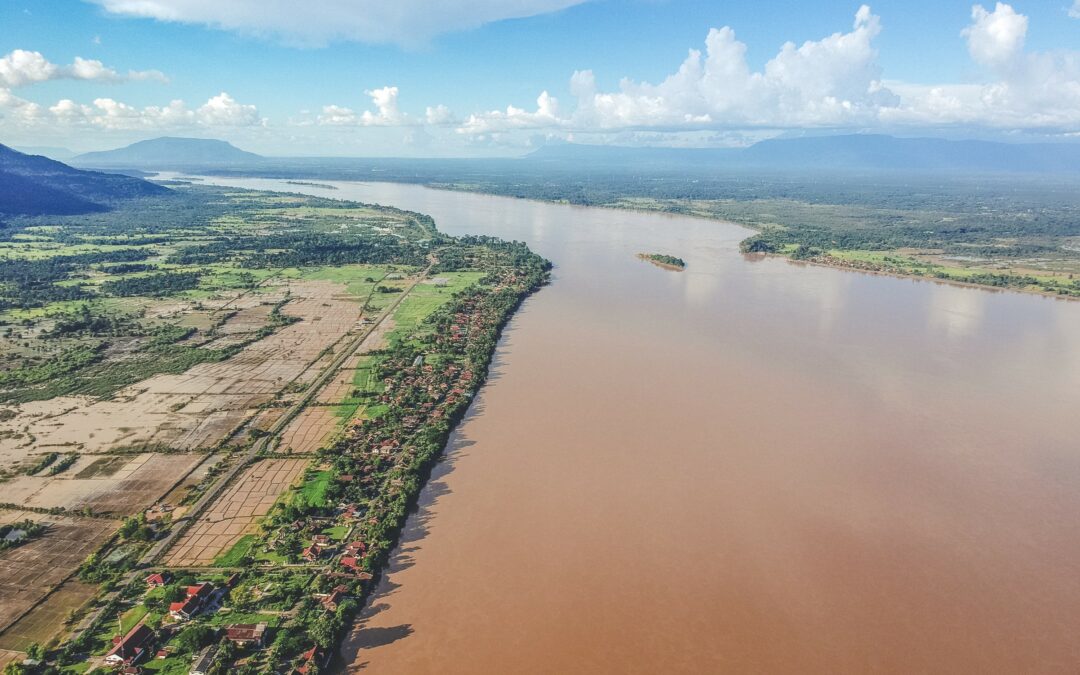
The best time to visit Southern Laos has two honest answers, and both are right. November to February is the most comfortable weather of the year: dry, bright, cool enough at night for a jumper. Late August to October is when the Mekong runs full, the plain is green and the light is the best you will see here. What follows is what each month actually feels like on the ground at Champasak, and what it lets you do.
The short answer
- Most comfortable weather: November to February.
- Best light and landscapes: late August to October.
- Hottest: March to May, peaking in April.
- Wettest: July to September.
- Biggest event: Boun Wat Phou, in February.
- Quietest: May, June and September.
Four seasons, not two
Guidebooks split the year into wet and dry. On the ground at Champasak the year has four distinct moods, and the difference between them is much bigger than a rain figure suggests.
Cool and dry: November to February
Daytime highs sit around 30 to 31 °C and nights drop to roughly 19 to 21 °C — the only time of year you may want long sleeves after dark. January is the driest month of all, with about 4 mm of rain across three rainy days and up to nine hours of sunshine a day. The plain is still green from the rains at the start of this window and turns gradually to straw by February.
This is high season, and it earns it. Wat Phou in the first hour after opening is close to perfect: cool stone, low light along the causeway, and the plain laid out below the sanctuary. Book early for December and January.
Hot and dry: March to May
April is the hottest month of the year, with highs around 35 °C and nights that barely fall below 25 °C. The plain is dusty, the light is flat and hard at midday, and the Mekong is at its annual low. This is not a reason to stay away — it is a reason to change your rhythm. Start at first light, come back for a long lunch in the shade of the garden, and go out again after four.
It is also when the Bolaven Plateau pays off most. The climb east of Pakse gains enough altitude to feel genuinely cooler, and Tad Fane — twin falls dropping about 120 metres into a forested gorge — is a good half-day out of the heat.
The rains: June to September
Each of these months exceeds 300 mm of rain. August is the wettest, averaging about 436 mm across some 28 rainy days, with humidity near 85 % and only around four hours of sunshine a day. Pakse takes roughly 2,084 mm across the year, and most of it falls in this window.
Read that honestly, but do not read it as a washout. Rain here tends to arrive in heavy bursts of an hour or two, often late afternoon, rather than as all-day drizzle. Between the bursts the air is washed clean, the rice is luminous, and the sky does things it never does in January. Rooms are easier to get and the site at Wat Phou is quiet. Bring proper sandals and accept that you will be wet at some point.
The high river: late September to November
The Mekong is at its lowest in April, starts rising in May or June with the monsoon, and reaches its annual peak around September in the lower reaches — as early as August upstream, as late as October further south. Late October into November is arguably the best fortnight of the year: the river is still high and fast, the land is still green, and the rain has largely finished.
What the river’s level actually changes
This is the part most seasonal guides leave out. The height of the Mekong decides what you can do from Champasak, not just how the view looks.
- Boat trips. High water from August to November makes the run downriver by wooden pirogue — to the pre-Angkorian temple of Vat Tomo, or the island of the abandoned prison — faster and smoother. At the April low, sandbanks surface and some channels close.
- Waterfalls. Khone Phapheng in the 4000 Islands, the widest waterfall in the world and the largest in South-East Asia by volume, is at its most overwhelming from August to October. By April it is a fraction of itself. The same goes for the Bolaven falls.
- Cycling. The ancient Khmer road and the ride out to Wat Muang Kang, the oldest active temple in Champasak, are best on dry tracks — November to March.
- Wat Phou. Fine all year. The long stone stairway is slippery after rain, and the spring at the sanctuary runs hardest in the wet months, which is the state the temple was designed around.
- Photography. September and October, an hour after a storm clears. Nothing in the dry season comes close.
The festival calendar
Lao festivals follow the lunar calendar, so the dates move each year. Ask us before you fix flights around one.
- February — Boun Wat Phou. The largest festival in Southern Laos, three days at the temple on the full moon of the third lunar month. Processions, music and dance, sports contests, sometimes an elephant procession. It closes on the full-moon day with morning alms to the monks and, in the evening, a candlelit circumambulation of the sanctuary. Pilgrims come from Thailand and Cambodia as well as across Laos.
- April — Boun Pi Mai. Lao New Year, and the hottest week of the year, which is the point: you will be soaked with water, cheerfully and repeatedly.
- May or June — Boun Bang Fai. The rocket festival. Villages launch homemade rockets to call the rains down for planting.
- July — Boun Khao Phansa. The start of Buddhist Lent, a quiet and inward festival.
- October — Boun Ok Phansa. The end of Lent, marked with longboat races and, in the evening, hundreds of little rafts of flowers and candles set adrift on the Mekong.
Month by month, at a glance
| Month | Weather | The river | Good for |
|---|---|---|---|
| Nov–Dec | Dry, warm days, cool nights | Falling from its peak, still high | The best all-round window |
| Jan | Driest and sunniest month | Dropping | Wat Phou at dawn, cycling |
| Feb | Dry, warming up | Low | Boun Wat Phou |
| Mar–May | Hot, up to about 35 °C in April | Annual low | Bolaven Plateau, early starts, Pi Mai |
| Jun–Jul | Rains begin, heavy bursts | Rising fast | Green plain, few visitors |
| Aug–Sep | Wettest, most humid | Peak | Waterfalls, boat trips, photography |
| Oct | Rain easing, still green | High | Boun Ok Phansa, the whole region at its best |
So when should you come?
- First visit, comfort matters, limited time: November to February. Pair it with our three-day itinerary.
- You care more about landscapes than thermometers: late September to October. Wettest weeks behind you, river at its fullest.
- You want the region to yourself: June, or September. Fewer visitors, lower rates, and Wat Phou almost empty.
- You are coming for the festival: February, and book well ahead — the whole province fills up.
However you time it, the Mekong is worth the trip on its own: about 4,900 kilometres long, and the second-richest freshwater biodiversity in the world after the Amazon. From the sala at our restaurant you can watch it change over a week, let alone a season.
Practical notes
- Getting here: fly to Pakse (PKZ), then about 40 km and an hour by road to Champasak. We arrange private transfers from the airport and the Cambodian and Thai borders.
- What to pack: November to February, a light layer for the evenings. March to May, sun protection and a hat. June to October, a light rain shell and sandals that dry.
- Staying: Residence Bassac has 14 rooms in a restored early-twentieth-century trading house on the riverbank. Our guide to where to stay in Southern Laos covers the wider region.
- What to do once you are here: see activities and the best things to do in Champasak.
- Festival dates, boats and guides: contact us — lunar dates shift and river conditions change, so ask rather than guess.
Temperature and rainfall figures are long-term averages for Pakse; any given year will differ. Opening hours, fees and transport prices change — check with us before you travel.
Recent Comments