
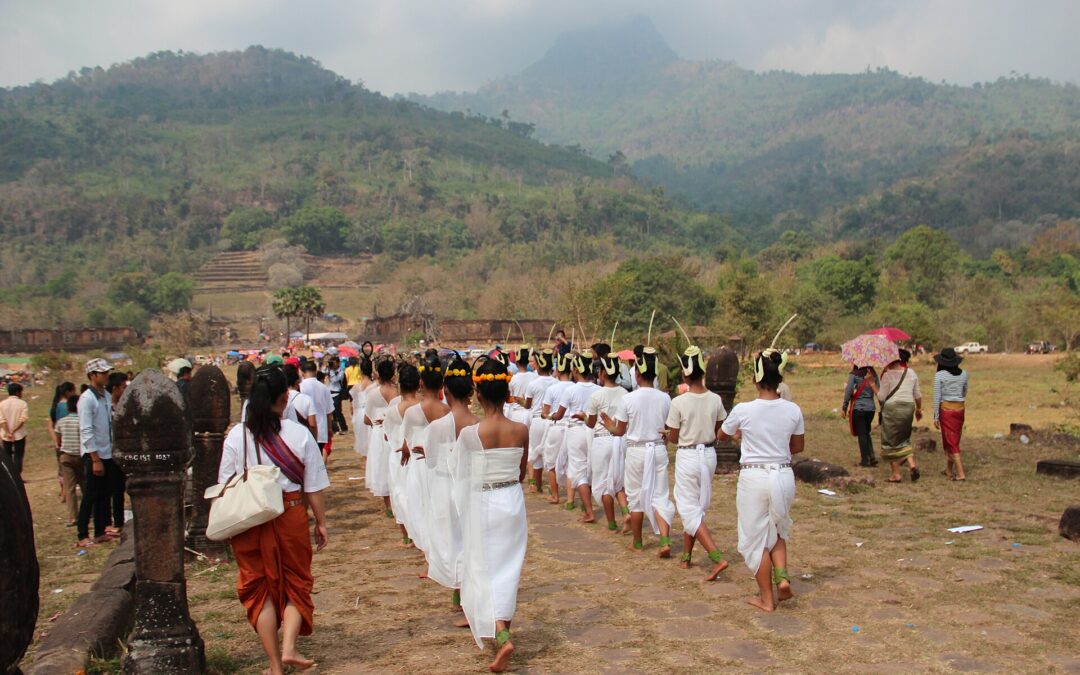
For most of the year Wat Phou is a quiet place. You walk the causeway between the two reservoirs, climb the terraces towards the cliff, and the loudest thing on the hill is the wind in the trees. Then, once a year, at the full moon of the third lunar month, the whole of southern Laos turns up.
Boun Wat Phou is the largest festival in Champasak province and one of the largest in the country. It lasts three days, it takes place on the temple grounds themselves, and it draws thousands of people — pilgrims from the surrounding plains and hills, and visitors who have crossed over from Thailand and Cambodia for it. This guide covers what the festival marks, when it falls, what happens on each of the three days, and how to see it properly.
What the festival marks
The date is not arbitrary. Boun Wat Phou is the Champasak expression of Magha Puja — Makha Bousa in Lao — the Buddhist observance that commemorates the day 1,250 monks came to hear the Buddha preach, having gathered without any summons or arrangement. It is marked across Laos, Cambodia, Thailand and Sri Lanka, and it always falls on the full moon of the third lunar month.
What makes Champasak’s version different is where it happens. The ceremonies are held at a temple that was a place of worship long before it was a Khmer sanctuary: the site grew up around a spring and an offering place for a tutelary spirit, and the mountain above it, Phou Khao, was taken to be the dwelling of Shiva. It has been on the UNESCO World Heritage list since 2001. So the alms-giving takes place on stone that has absorbed several religions in sequence, which is not something you can say of many festivals.
When it falls — and why nobody can tell you in October
The rule is fixed even though the date moves: three days ending on the full moon of the third lunar month, which puts the festival in late January or February. In practice it has fallen on 3-5 February in 2023, 10-12 February in 2025, and 17-19 February in 2019.
For 2027, Magha Puja falls on 21 February, which points to roughly 19-21 February 2027 — but treat that as an expectation rather than a booking. The provincial programme is usually confirmed only one or two months beforehand, and the published dates can shift by a day. If February 2027 is the reason you are coming, write to us and we will confirm as soon as the province does.
The three days
The shape of the festival is consistent from year to year, even when the details change.
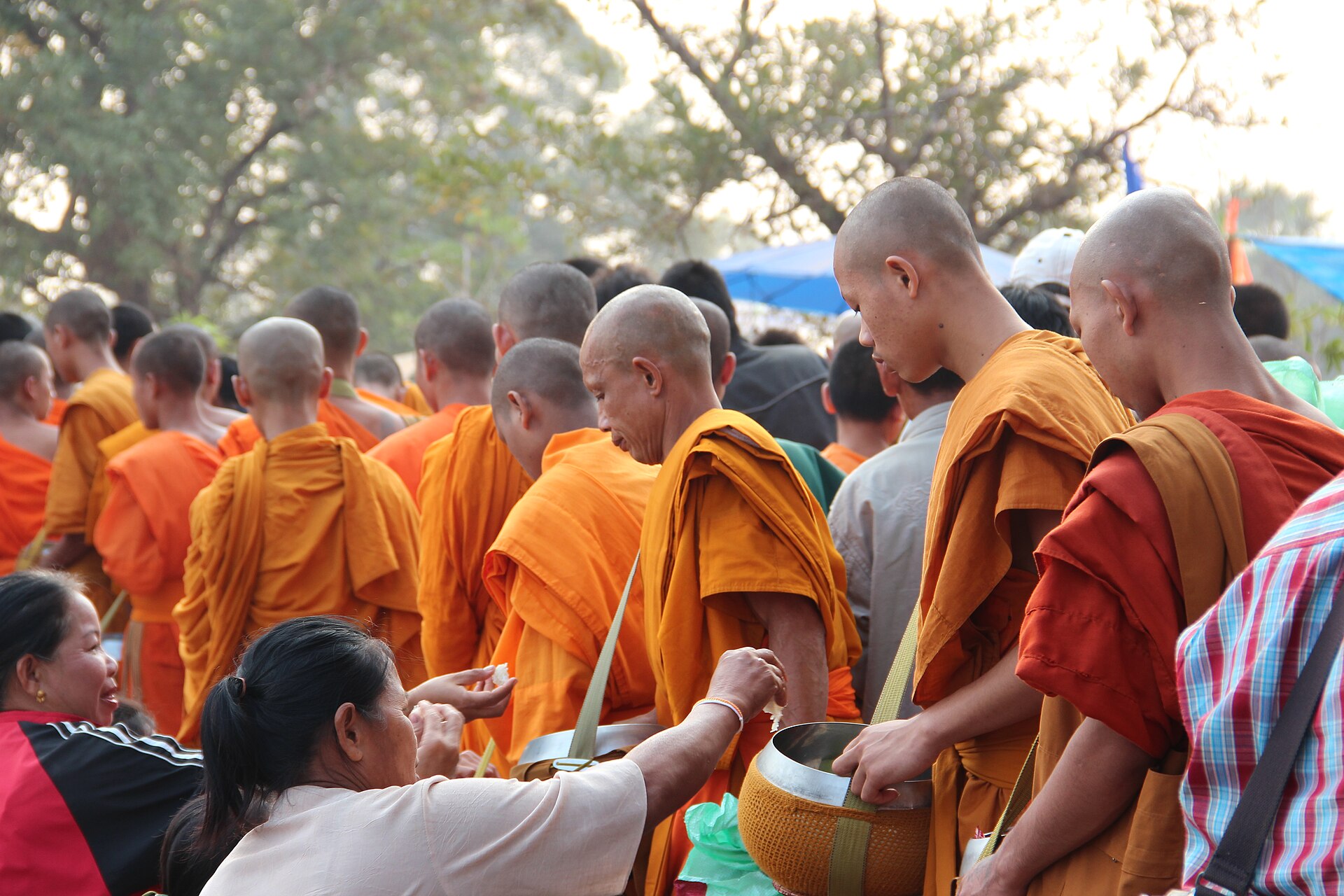
The religious core. Processions, recitations and chanting run through all three days, with monks and lay pilgrims moving up and down the terraces. On the final morning the main alms-giving ceremony — the tak bat — brings hundreds of monks together with senior religious figures and dignitaries from around the country. In the evening there is a vien tian, a candlelit circumambulation of the lower shrines, which is the most photogenic hour of the three days and also the quietest.
The fair. Alongside the ceremonies there is a proper trade fair, with produce and crafts from the southern provinces and from neighbouring countries, and food stalls running late. Traditional music and dance go on into the night, and recent editions have added a parade, historical re-enactments, fireworks and a sound-and-light show against the temple.
The games. Dugout boat races on the Mekong, volleyball, petanque, duck-catching contests and muay lao bouts. Older programmes also listed elephant processions and animal contests; what actually appears varies from one year to the next.
Seeing it well
Split your day. The sacred and the secular sides of Boun Wat Phou happen in the same place but not at the same hours, and trying to have both at once is how people end up enjoying neither. Go up at first light for the ceremonies, when it is cool and the crowd is still composed of people who came to make merit. Come back in the evening for the music, the food and the candles.
Dress as you would for any active temple — shoulders and knees covered — and remember that the tak bat is a devotional act, not a display. Stay low, stay back, and do not put a lens between a monk and the person making the offering.
Stay on this side of the river. Most festival traffic comes down from Pakse in the morning and goes back at night; sleeping in Champasak itself means you are already there, and you can be on the terraces before the coaches arrive. Book early — the village has a small number of rooms and this is the one week of the year they all go.
Getting here, and where to stay
Champasak is reached via Pakse, and our guide to getting to Champasak sets out the options by air, road and river, along with the border crossings. Allow more time than usual in festival week.
Residence Bassac is on the west bank in the village, fourteen rooms in a converted trading house, a short run from the temple. Our rooms and suites look out over the Mekong and the garden, and the travel desk can arrange transport to the site and back at the hours you actually want, rather than the hours the tours run.
If you cannot come in February
Do not let the festival become the only reason to see Wat Phou. The site is at its best in the dry season generally — November to April — when the light is clean, the water is low and the climb is comfortable. Our complete guide to visiting Wat Phou covers the layout, the terraces, the carvings and the best hours of the day, in a month when you will have the upper sanctuary largely to yourself.
Festival photos: GuillaumeG — Boun Wat Phou 2012, Wikimedia Commons — CC BY-SA 3.0.
Recent Comments