
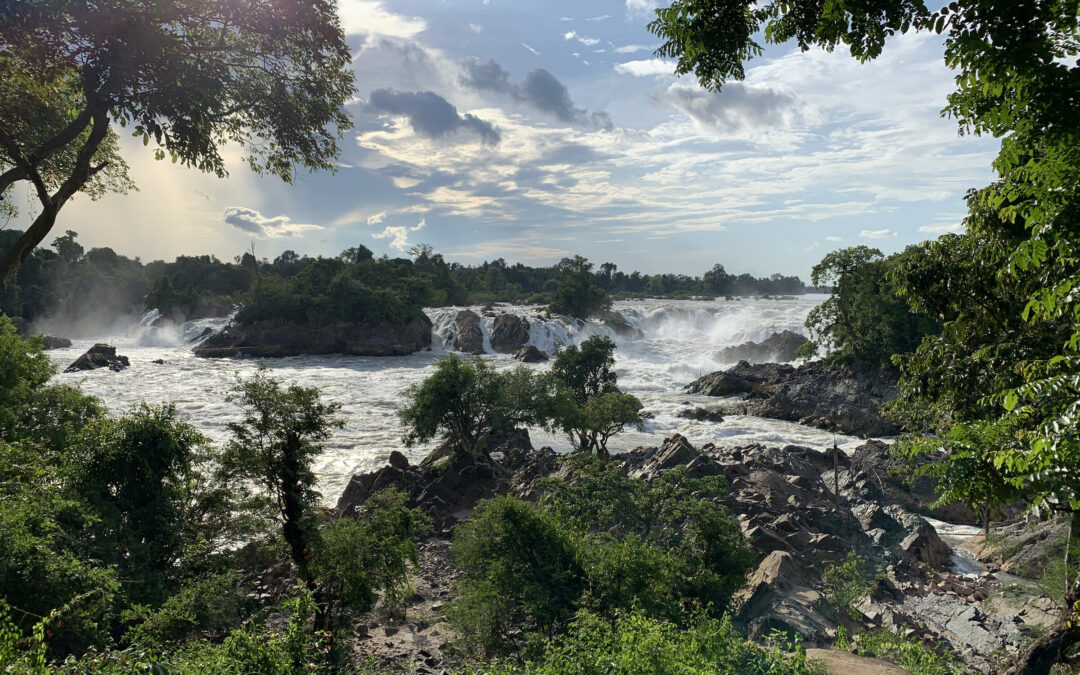
Visiting the 4000 Islands from Champasak means following the Mekong south to the point where, on the Cambodian border, the river spreads into an archipelago of sandbanks, sugar palms and paddy fields before crashing over the Khone Phapheng Falls. The Lao call it Si Phan Don, “four thousand islands”. The number is an image rather than a count: in the dry season thousands of sandbanks surface; in the rainy season only a handful of large, inhabited islands remain. It is a day’s outing from Champasak, and one of the most unusual landscapes anywhere on the Mekong.
What to see
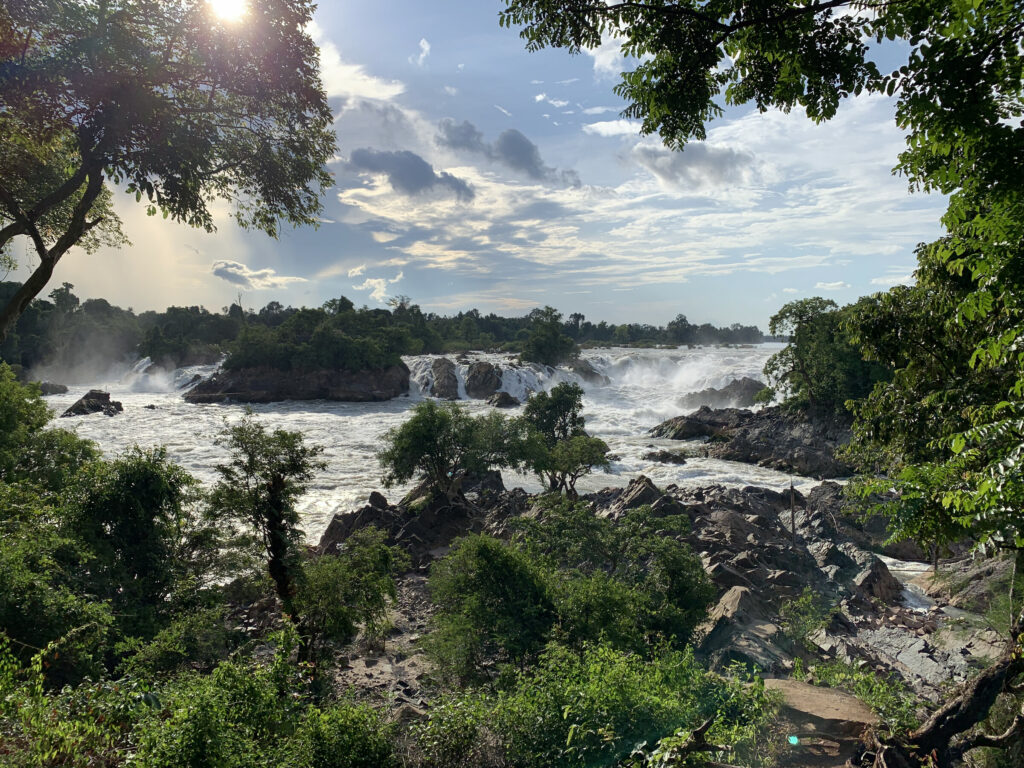
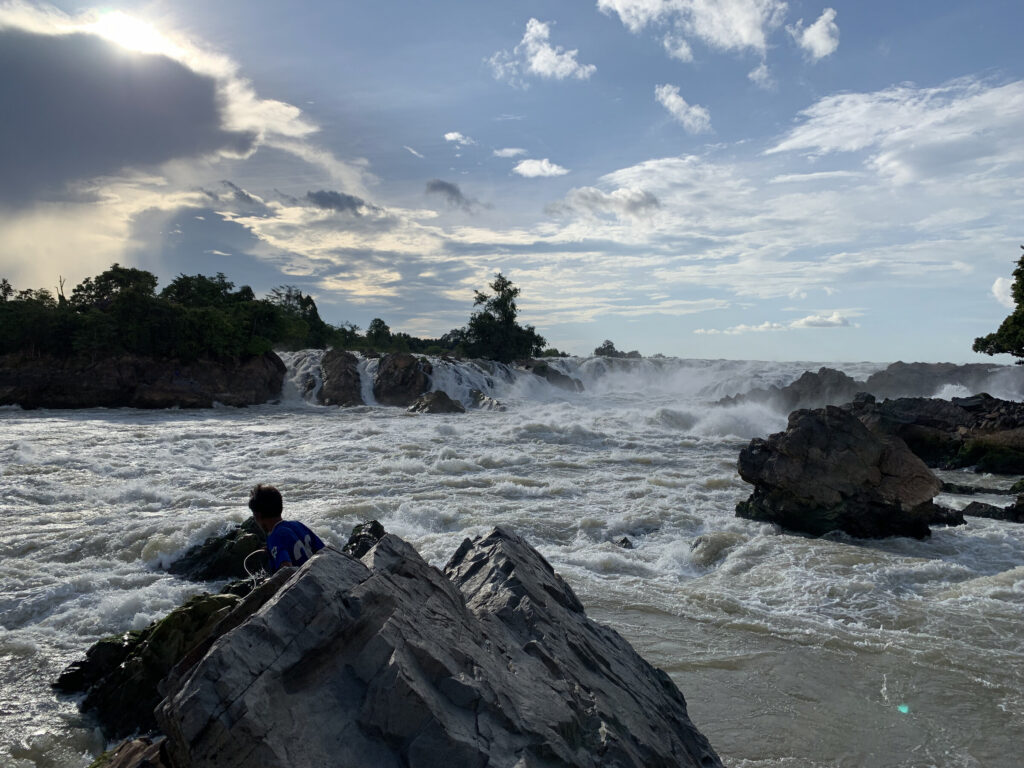
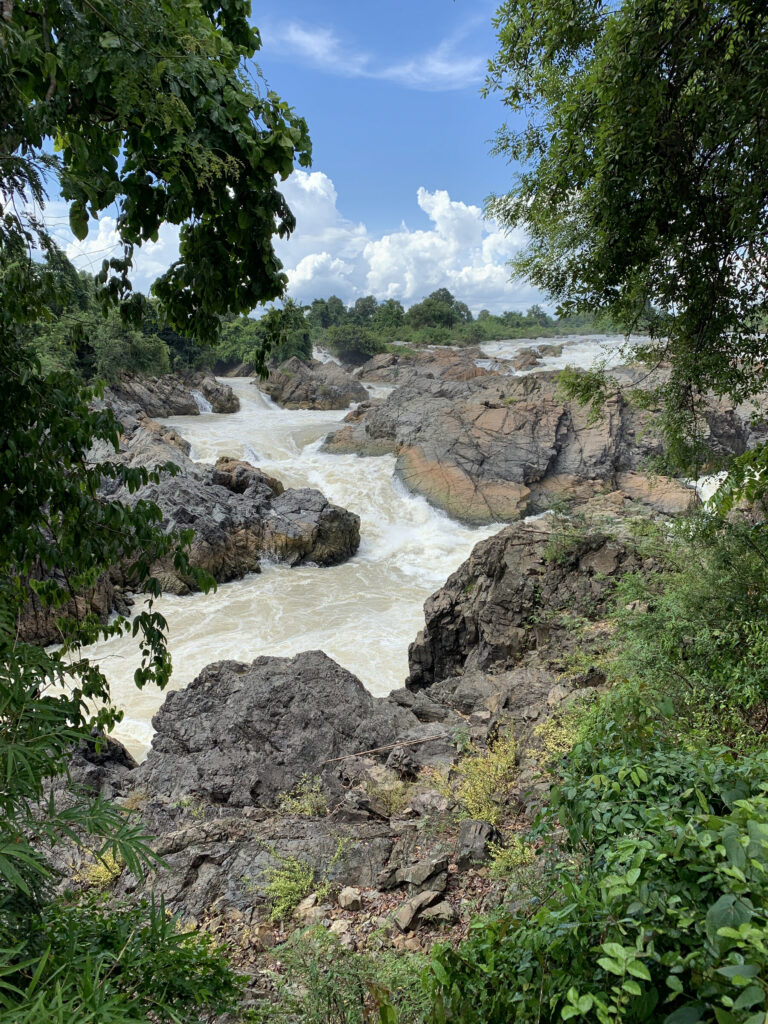
Khone Phapheng Falls. Not a single vertical drop but a chain of rapids blocking the river across nearly eleven kilometres, with steps of around twenty metres. By volume it is the largest waterfall in South East Asia: on average close to 11,000 cubic metres of water a second, and far more at the height of the monsoon. You hear the roar before you see the water. A viewing area on the east bank lets you walk along the edge of it.
Don Khon and Don Det. The two islands are joined by a concrete bridge left by the French. Don Khon is the quieter of the two: you cycle between stilt houses, village temples and rice fields. At the southern end, the Tad Somphamit falls, known locally as Li Phi, thunder between black rocks. Local legend calls them a trap for bad spirits; nobody swims there. Don Det, to the north, is livelier, with riverside guesthouses facing the sunset.
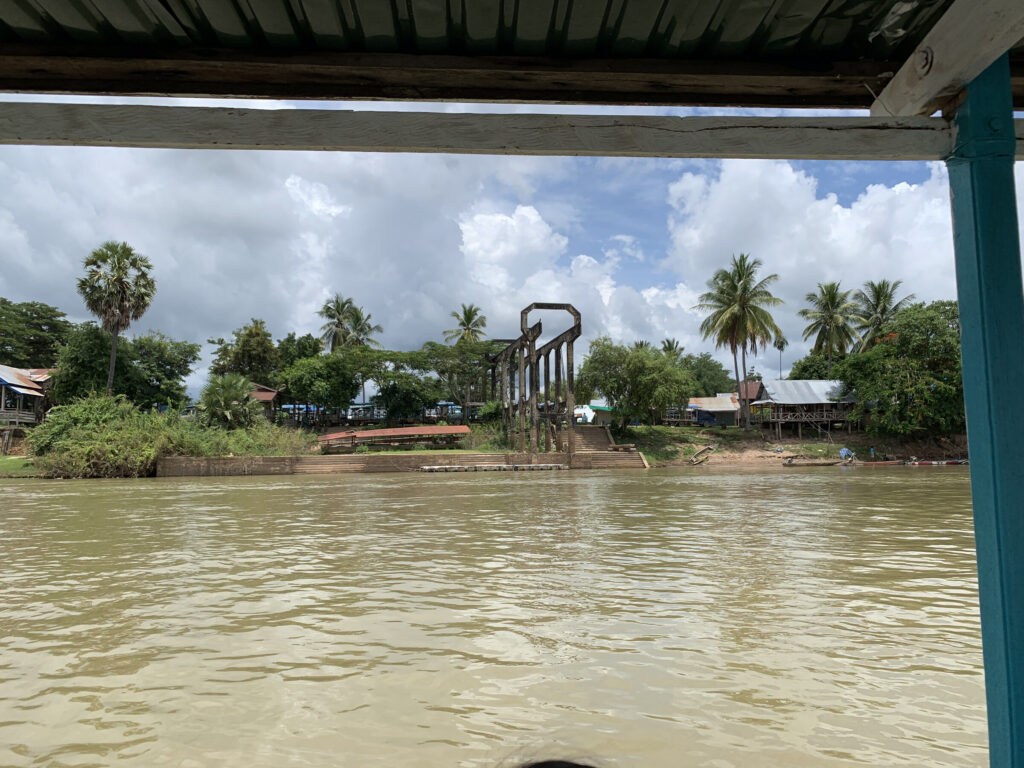
The old railway. This is the archipelago’s most surprising story. French explorers tried three times, in 1891, 1892 and 1893, to take steamboats up the falls. All three attempts failed. So from 1893 they built a narrow-gauge railway on Don Khon, extended to Don Det in the 1910s, seven kilometres in all: boats were dismantled downstream, carried across on rails and reassembled upstream. The line closed in the 1940s. What remains is the 170-metre viaduct between the two islands, the old trackbed you can now cycle along, and, at Ban Khon, the locomotive Eloïse, built in 1911, the only steam engine left in Laos.
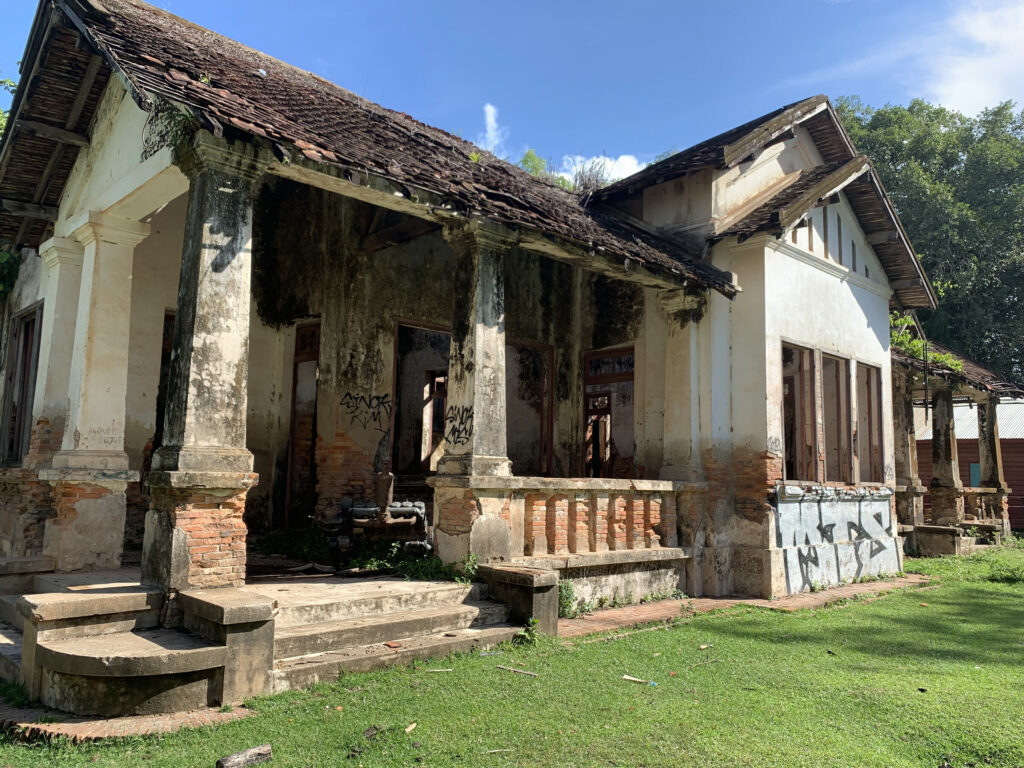
Don Khong. The largest island, further upstream, is also the most peaceful: a road around its edge, fishing villages, rice fields to the horizon. It is where travellers stay when they want a night in the islands without the bustle of Don Det.
What about the dolphins?
You will still read everywhere that Irrawaddy dolphins can be seen off the southern tip of Don Khon. That is no longer true. The last member of the Lao population died in February 2022. Trips are sometimes offered on the Cambodian side further south, but from the 4000 Islands there are no dolphins left to see. We would rather say so plainly than let you pay for a boat trip that shows you nothing.
Getting there from Champasak
The 4000 Islands lie south of Champasak on the same river, but the road runs along the east bank. You cross the Mekong, join Route 13 and head due south to Nakasang, the landing for Don Det and Don Khon. Allow around two and a half hours’ drive, then a fifteen-minute boat ride. Don Khong is reached a little further north, by the bridge linking the island to the bank. The simplest option from the Residence is a private car and driver for the day: an early start, Khone Phapheng late morning, Don Khon by bicycle in the afternoon, and back in time for dinner on the Sala. We arrange this day for our guests: see our 4000 Islands getaway.
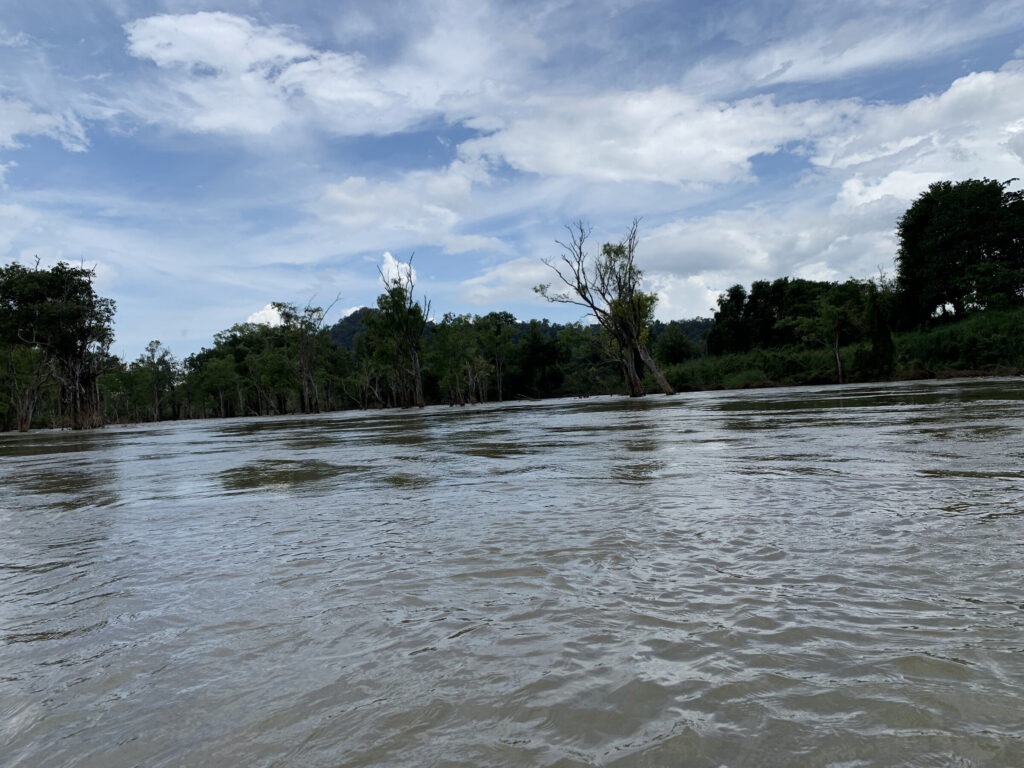
With an extra night, sleep on Don Khon or Don Khong and carry on to Pakse or Cambodia the next day. The border crossing is a few kilometres south of Nakasang.
When to go
From November to April, in the dry season, skies are clear, the river is low and the sandbanks give the archipelago its name. It is the most comfortable time to cycle on Don Khon. From May to October the Mekong runs high and Khone Phapheng is at full force: fewer islands, but a far more dramatic show of water. Both seasons are worth the trip; they simply show you different things.
Our tips
- Leave early: the morning light on the falls is the best, and the heat builds quickly after midday.
- On Don Khon, hire a bicycle at the landing rather than a tuk-tuk: the island takes two hours to cover and the old railway is flat all the way.
- Bring a hat, water and sun protection: there is little shade at the viewpoints.
- Do not swim near the falls or the rapids; the current is deceptive even in the dry season.
- If waterfalls are your thing, the Bolaven Plateau is the other great day out from Champasak, in a completely different setting.
The 4000 Islands combine naturally with Wat Phou and the Bolaven Plateau in a three-day Southern Laos itinerary, with Residence Bassac as your base. Our rooms look out over the garden and the river; it is the same Mekong that, a hundred kilometres downstream, pours over the falls.
Recent Comments