
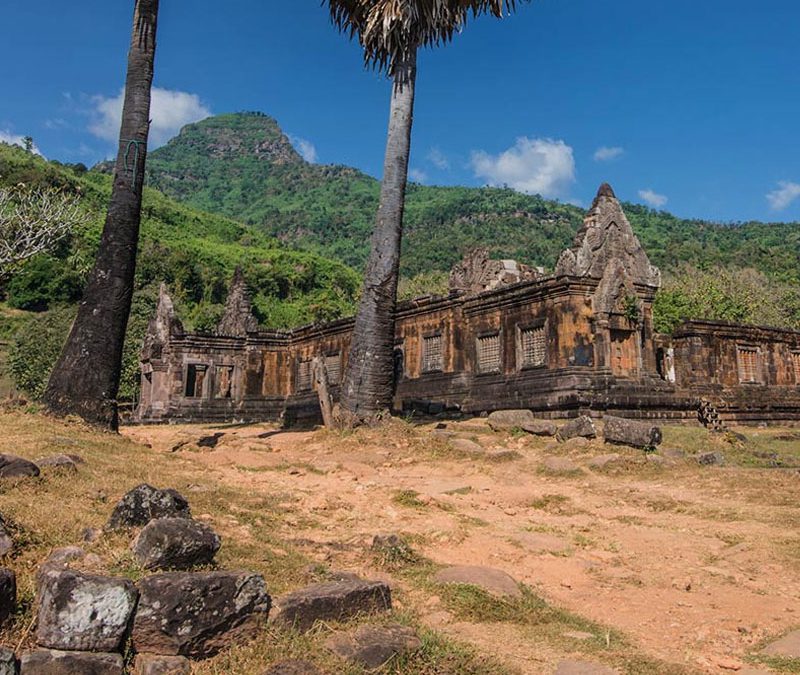
Perched at the foot of the sacred Phou Khao mountain, just a short journey from the town of Champasak, Wat Phou is one of Southeast Asia’s most atmospheric ancient sites. This pre-Angkorian Khmer temple complex was inscribed on the UNESCO World Heritage List in 2001, and it remains one of the great reasons travellers make their way to Southern Laos.
A temple older than Angkor
Wat Phou (also spelled Vat Phou) was originally a Hindu sanctuary dedicated to the god Shiva. Its builders chose the location for a reason: a natural spring emerges from the mountainside above, and the peak itself was revered as a sacred lingam. Although many of the surviving stone structures date from the 11th to 13th centuries, the site was a place of worship for centuries before that, making it older than the famous temples of Angkor in neighbouring Cambodia.
More than one temple: the Champasak Cultural Landscape
What UNESCO inscribed on 16 December 2001 was not a single monument. The property is listed as Vat Phou and Associated Ancient Settlements within the Champasak Cultural Landscape, under cultural criteria (iii), (iv) and (vi), and it covers a planned landscape more than a thousand years old. Its organising idea is an axis running from the summit of Phou Khao down to the bank of the Mekong, and along that line the Khmer laid out temples, shrines, reservoirs and water channels over some ten kilometres. The remains span a long period — roughly the fifth to the fifteenth centuries — so what you walk through is less a building than a plan: a Hindu reading of the relationship between mountain, water and human settlement, still legible in the ground today.
What to see at Wat Phou
The complex unfolds along a grand axis that climbs gradually towards the mountain. Highlights include:
- The lower palaces – two ruined pavilions flanking the ceremonial causeway, decorated with intricate carvings.
- The frangipani-lined stairway – a romantic, shaded climb towards the upper sanctuary.
- The main sanctuary – where you’ll find beautiful lintels depicting Hindu deities, later adapted for Buddhist worship.
- The sacred spring – still channelled towards the sanctuary, along with rock carvings of an elephant and a crocodile.
From the upper terrace, the view stretches back across the plain towards the Mekong River – a perfect spot to pause and take it all in.
Hong Nang Sida and the road to Angkor
About two and a half kilometres south of the main sanctuary stands Hong Nang Sida, part of the same World Heritage property and one of the most intriguing ruins in the area. It collapsed long ago and was left to the forest for decades; since 2013 a Lao–Korean heritage programme has been dismantling, documenting and re-erecting it stone by stone. Hong Nang Sida also marks the beginning of the ancient Khmer road that once ran south-east towards Angkor, and further along the same alignment lies the small temple of Thao Tao. Very few visitors go beyond the main sanctuary, which is precisely what makes these two stops worth the detour. Our guide to cycling the west bank covers both in detail.
When to visit
The cooler, drier months from November to February are the most comfortable time to explore. Aim to arrive in the early morning, both to avoid the midday heat and to enjoy the softer light on the ancient stone. If your travels bring you here around the full moon of the third lunar month (usually February), you may catch the vibrant Wat Phou Festival, when pilgrims and visitors gather for ceremonies, music and celebration.
Getting there from Residence Bassac
One of the joys of staying in Champasak is how close you are to Wat Phou – it is only a short drive from town. Guests of Residence Bassac can set out early, explore the temple at a gentle pace, and be back beside the Mekong in time for lunch at Soum Noum. Our team is always happy to help arrange transport and share tips for making the most of your visit.
Seeing it by bicycle, and the site museum
The temple lies roughly ten kilometres from the centre of Champasak and the road is flat the whole way — there are no hills between the town and the mountain. That makes the bicycle the most enjoyable way to arrive: an hour of gentle pedalling past rice fields and wooden houses, ideally setting off soon after the gates open, before the heat builds. Bicycles can be hired in the village, and we keep a few at the Residence for our guests. On the site itself, make time for the small museum near the entrance: it holds lintels and statuary recovered from the complex and it puts the carvings you are about to see into context. It closes a little earlier than the temple grounds, so it is better seen on the way in than on the way out.
Practical tips
- Dress modestly, as this remains a place of worship.
- Bring water, sun protection and comfortable shoes for the stairs.
- Allow two to three hours to enjoy the site without rushing.
Frequently asked questions
How long should I allow for Wat Phou?
Two to three hours is right for the main complex at an unhurried pace. Allow half a day if you add the site museum and Hong Nang Sida, and another hour each way if you cycle from Champasak.
Is Wat Phou really older than Angkor?
Most of the standing stone structures date from the eleventh to thirteenth centuries, so they overlap with Angkor. But the site was a place of worship long before that: the World Heritage property spans the fifth to the fifteenth centuries, and the sacred spring and the mountain itself were venerated earlier still.
Can Wat Phou be visited on a day trip from Pakse?
Yes — Pakse is roughly an hour away by road, so a day trip is perfectly possible. Staying in Champasak simply means you can be at the gates when they open and have the causeways almost to yourself.
Ancient, serene and steeped in history, Wat Phou is an unforgettable introduction to the cultural riches of Champasak. Plan your stay at Residence Bassac and let this remarkable corner of Laos work its quiet magic.
Recent Comments