
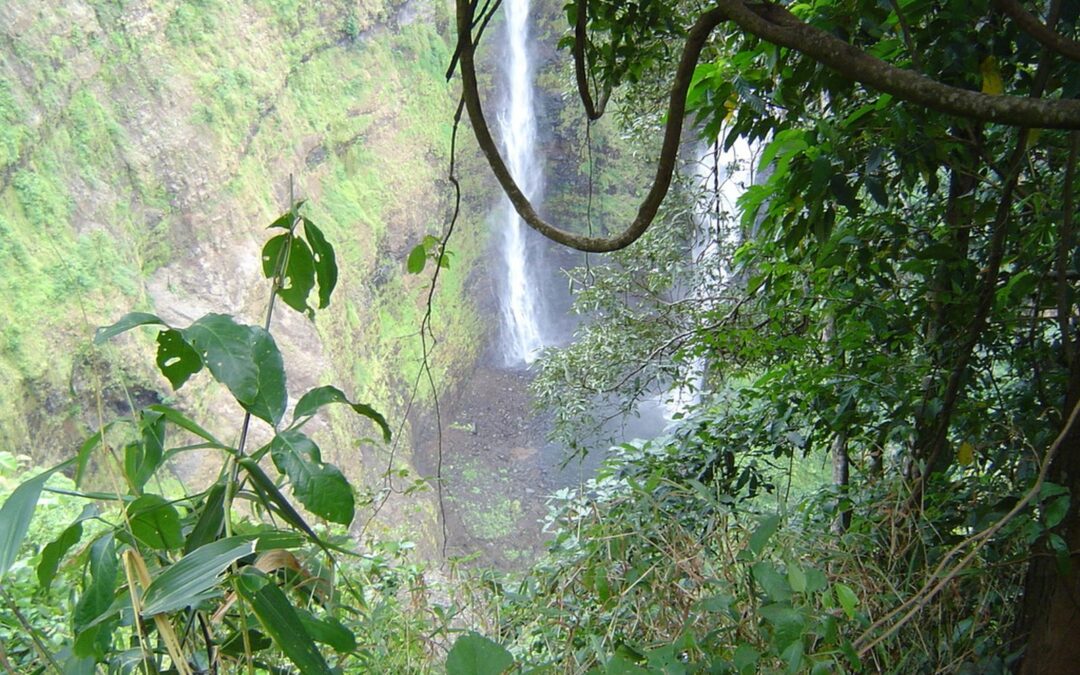
The Bolaven Plateau waterfalls are the reason most travellers climb east of Pakse. Sitting 1,000 to 1,350 metres above sea level, this volcanic plateau catches far more rain than the Mekong plain below, and the water spills off its edges in dozens of falls. Some are a short walk from the road, others sit at the bottom of a long staircase, and all of them change character between the rainy season and the dry season. This guide sorts out which ones are worth your time, how they group on the map and what the season does to each, so you can plan a day from Champasak without driving in circles.
Where the falls are
Most visitors reach the plateau on the road from Pakse to Paksong, the market town at the heart of the coffee country, about 50 km east of Pakse. The best-known falls cluster around 38 to 40 km from Pakse, roughly 10 km short of Paksong, within a few kilometres of one another. That grouping is what makes a day trip from Champasak realistic: count about an hour from Champasak to Pakse, then the climb.
A second group lies further north around the village of Tad Lo, in Salavan province, some 85 to 90 km from Pakse. It is better kept for an overnight stay than squeezed into the same day.
The falls near Paksong
Tad Fane, the twin falls
Two parallel streams drop about 120 metres into a forested gorge inside the Dong Hua Sao National Protected Area. Tad Fane is often described as the highest waterfall in Laos. You do not walk down to it: you look at it from a viewpoint across the gorge, which is exactly where the scale makes sense. This is the one to see if you only have time for one.
Tad Yuang, the one for swimming
A wide curtain of water falls over a rock ledge into a large pool, reached by an easy set of steps. When the flow is moderate, it is the most comfortable place in the group for a swim, and the spray often throws a rainbow across its base.
Tad Champee, the quiet one
Smaller and less visited, Tad Champee has a path that runs behind the curtain of water and a natural pool at its foot. It is a good place to slow down after the busier viewpoints.
Tad Gneuang, the powerful one
A strong fall watched from a series of platforms linked by walkways, with a long staircase down. It is one of the most photographed falls on the plateau. Expect to get wet from the spray.
Tad Lo and the northern falls
Around Tad Lo village, Tad Lo and Tad Hang are two falls a short walk apart, with riverside guesthouses close by: an easy, unhurried place to spend a night. On the way from Pakse, Tad Pha Suam is a horseshoe-shaped fall reached by wooden bridges. Further east, the Tad Tayicseua group of falls asks for two to three hours of steep, slippery walking and belongs to a longer loop of the plateau rather than a day out.
When the waterfalls are at their best
| Months | The falls | Good to know |
|---|---|---|
| August to October | At full power, the most spectacular time | Heavy spray, slippery steps, strong currents: admire rather than swim. Unsealed tracks can be muddy. |
| November to February | Still generous early in the season, then easing off | Clear skies, cool mornings on the plateau, coffee harvest under way. The most comfortable balance. |
| March to May | Much lower; by April some falls are a fraction of themselves | The plateau stays noticeably cooler than the plain, a welcome break from the heat. Pools are calmer. |
For the whole year in Southern Laos, month by month, see our guide on when to visit Southern Laos.
Coffee between two falls
The volcanic soil and cool, wet climate that feed the waterfalls also made the plateau the heart of Lao coffee. The French introduced Arabica and Robusta in the early twentieth century, and Robusta now makes up most of the crop. Around Paksong, small farms and cafés roast their own beans; the harvest runs from about October to February. The plateau takes its name from the Laven people, and it is also home to Alak, Katu and Suay communities.
A day from Champasak, in practice
- Leave early. About an hour to Pakse, then the climb towards Paksong. An early start leaves time to linger at each stop.
- Choose three falls, not six. Tad Fane for the view, Tad Yuang for a swim, Tad Champee for calm, then coffee in Paksong.
- Be back for sunset. The drive home puts you on the Mekong in time for dinner at Soum Noum, our riverside restaurant.
- Add a night for Tad Lo. With an extra day, combine the plateau with our three-day Southern Laos itinerary.
- Pack a warm layer, non-slip shoes, swimwear and small cash for entrance fees.
- Stay on marked paths. The plateau was heavily bombed during the Vietnam War, and unexploded ordnance remains in the countryside.
- Dress respectfully in villages: shoulders and knees covered.
Our Bolaven Plateau excursion leaves from the hotel by car at the time that suits you, over one to four days. The travel desk can also arrange your transfers and keep a room for your return to Champasak.
Recent Comments