



Don Daeng Island, Champasak: The Island Opposite, by Bike and on Foot
From the bank at Champasak you look straight past it: a long green line lying in the middle of the Mekong, ten minutes away by boat. Don Daeng Island is the island opposite, and it is probably the simplest and least crowded half-day in southern Laos. No bridge, no sealed road, no cars — just red earth tracks, rice fields, a handful of villages that face the water, and a flat loop you ride without thinking about it.
This guide covers what there is on Don Daeng, how to get round it, which season to come, and why the island belongs to the same story as the temple across the water.
An island inside the Wat Phou perimeter
Don Daeng runs some ten kilometres from north to south and about three at its widest. It lies within the protected zone of the World Heritage property because of its position facing Wat Phou — and that is not an administrative accident. The island formed part of the sanctuary’s wider layout, and the trace it has left is as discreet as you could imagine: an old brick stupa, hidden in the middle of the island, away from the main tracks, with a small group of Buddha images beside it.
It is the kind of monument you photograph not for the shock of it but for what it tells you. The Champasak plain was organised as a single whole: the temple on the flank of Phou Khao, the ancient cities on the river bank, the causeways, and the island in mid-current. The Mekong was not a boundary, it was the axis. Our guide to visiting Wat Phou covers the monumental half of that story; Don Daeng is the rural half, the one that has never stopped being lived in.
What you do on the island
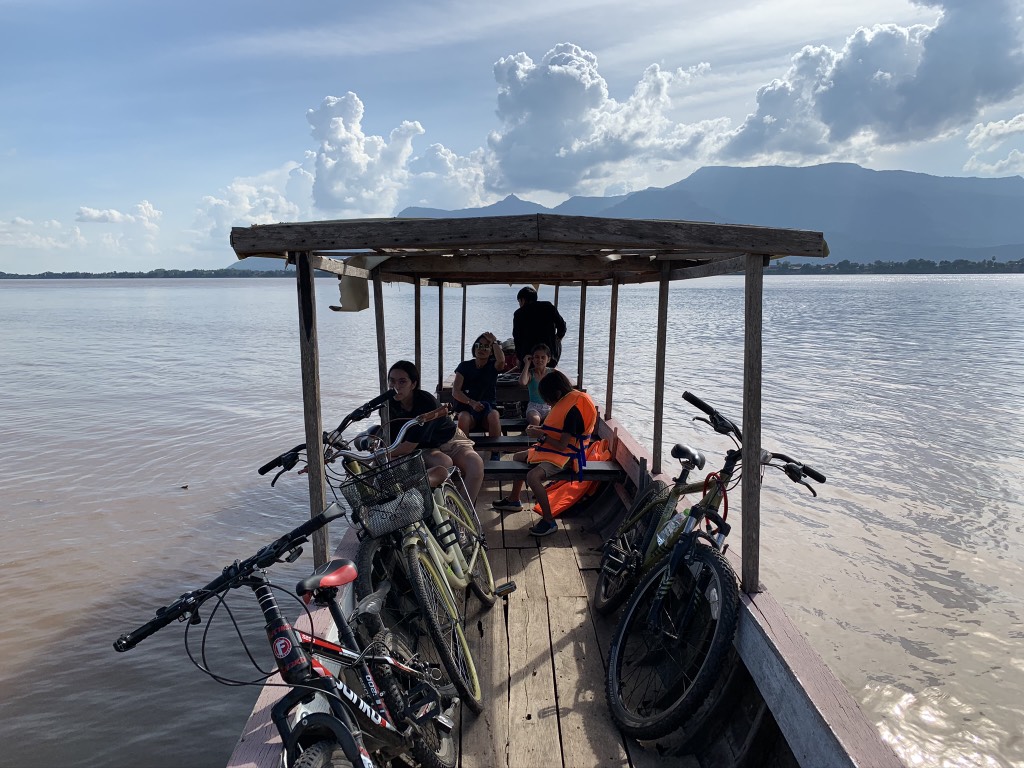
The cycling loop. This is the main reason to cross. A track follows the shore right round the island for a distance to be confirmed for your chosen route, entirely flat, on packed earth. It runs through the fishing villages strung along the bank, skirts the rice fields, and gives you a view of the river on one side or the other roughly every hundred metres. Allow two to three hours with stops, and considerably more if you talk to people, which always ends up happening. You hire the bikes in Champasak and load them onto the boat: that is how it is done.
The stupa and the middle of the island. The inner tracks cut across the rice fields and lead to the old stupa. Guides from the village know exactly where it is, which is useful, because nothing marks it.
The sandbanks. From November to March the water drops and uncovers long sand beaches along the island. They are occupied by fishermen and by buffalo, which is precisely their charm — these are not managed beaches, they are seasonal sandbanks. Late in the day, with the light coming in low and Wat Phou somewhere behind you on the west bank, this is one of the best places in Champasak to watch the sun go down.
The villages. Single-storey wooden houses, temples, the odd loom under the floorboards, children coming home from school along the track. There is nothing to visit in the strict sense, and that is exactly the point: Don Daeng is one of the few places in the south where daily life has not yet been reorganised around visitors.
Getting there from Champasak
The crossing is made by wooden boat from the Champasak landing, and it is short — the island is right there. There is no timetable in the sense you would expect elsewhere: you leave when the boat leaves, and you agree the return before you step off. That is the one thing to settle properly — fix the return time with the boatman before you go anywhere, and keep some margin, because once you are on the island you will not find a taxi.
For a first visit the simplest route is through the hotel travel desk, which arranges the boat, the bikes and, if you want one, a village guide to find the stupa. Our activities also cover the other river excursions, including the spiritual journey on the Mekong by wooden boat, which passes off the southern tip of Don Daeng on its way down to the temples.
When to go
The dry season, November to April, is the right answer for almost everything: the tracks are firm, the dust is bearable in the morning, the sandbanks are uncovered and the sky is clear. It is also high season at Wat Phou, and Don Daeng offers a useful contrast then — a few hundred metres of water is all it takes to find quiet again.
From May to October the island is greener than at any other time of year, the rice fields are under water and the light between showers is spectacular. But the Mekong is high, the earth tracks turn slippery in places, and the beaches have gone. The crossing then depends on river conditions; the full cycling loop, much less so.
Whenever you come, start early. There is almost no shade on the shore track, and by midday the going is hard. Take water: do not rely on finding an open shop along the route.
Making a day of it
Don Daeng combines well with what is on offer on the other side. A morning on the island, lunch back on the west bank, and the afternoon in the shade or at the temple: it makes a rewarding day out. If you would rather stay on dry land, our cycling Champasak west bank itinerary offers the equivalent without a crossing, and our round-up of the best things to do in Champasak puts all of it inside a two- or three-day stay.
Residence Bassac is a few minutes’ walk from the boat landing, on the west bank. From our rooms the island is the green line opposite: it is the shortest excursion of the whole stay, and one of the most memorable.
